
|
||
|
Dongcai · EAST MARKET · 1908
A century-old kitchen for the old city gentry
|
| Written by | an editor devoted to the lanes of Tainan |
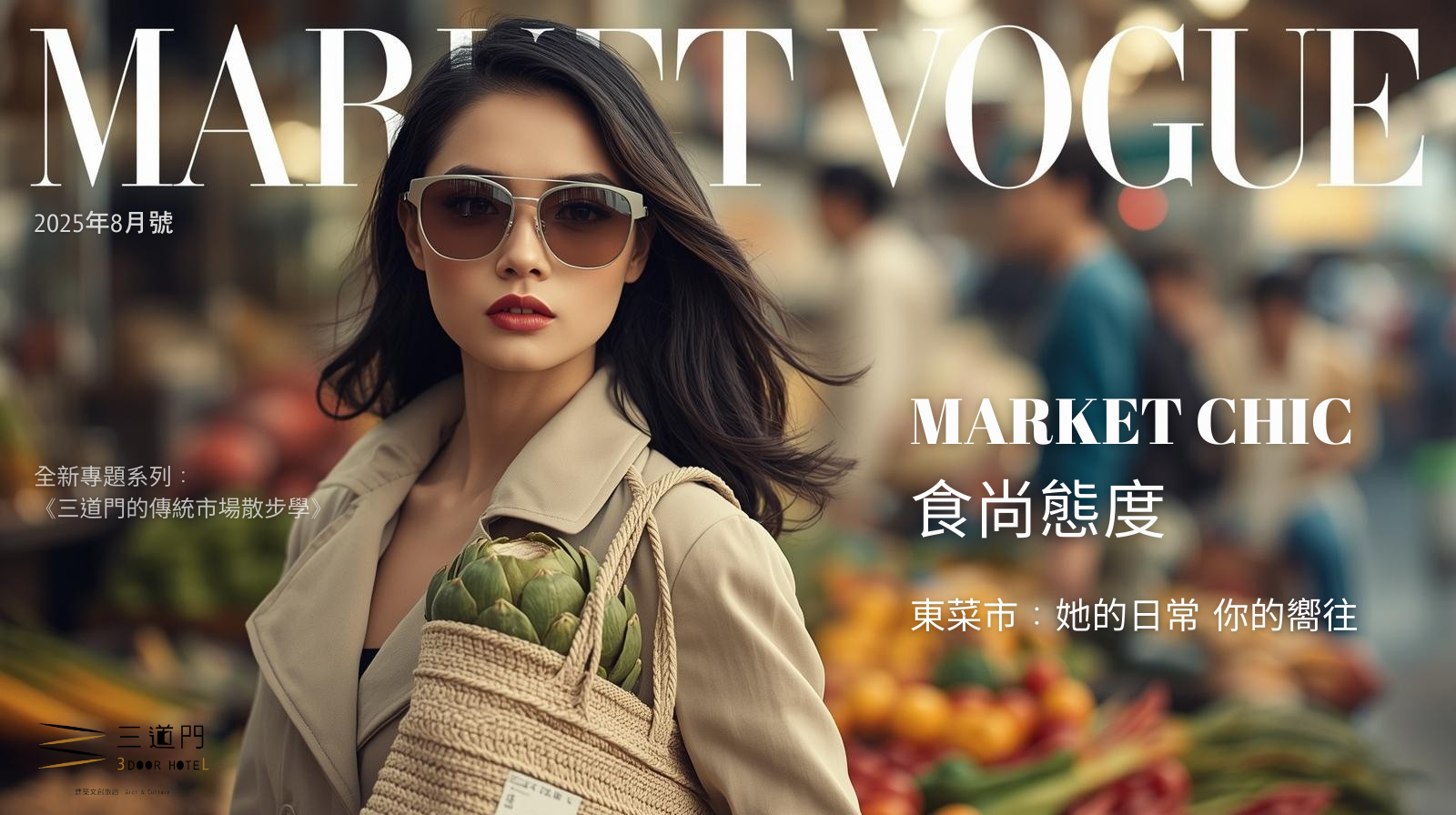
Market Vogue has never set out to be a food map. We believe a city’s most honest soul lies in its markets — the place where money, human feeling, the seasons and trust are all settled afresh each morning.
And among Tainan’s many markets, we choseDongcai Marketto open this series, because it is so distinctive: other markets teach you cheapness, Dongcai teaches you discernment; other markets compete in volume, Dongcai competes inthe confidence not to haggle. Here, buying food is not a transaction but an elegant ritual of trust.
If you are looking for somewhere in Tainan from which you can walk straight into a century-old market, the next five thousand words are the best possible ticket to knowing the old city. Come with us through that door on Qingnian Road.
|
PROLOGUE
An aristocratic drawing room where time stands still |
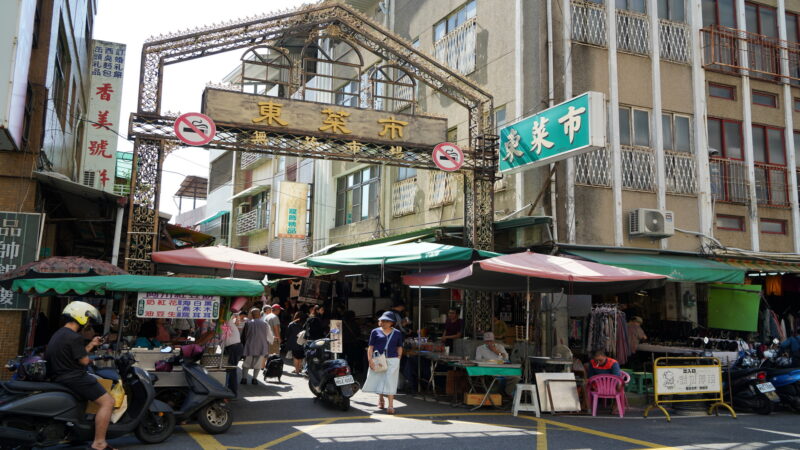
IfYamuliao Market is Tainan’s fierce battlefield, thenDongcai Marketis without question the city’s most elegant aristocratic drawing room. It neither shouts nor jostles, yet it carries an atmosphere that slows your step without your noticing.
Walking in from Qingnian Road, you will first be struck by itsbrightness and composure. There are no scooter fumes competing for the aisle and no hoarse calls to buy. The high colonial steel frame lets air circulate naturally, sunlight falls gently through the skylights onto the stalls, and even the drops of water on the vegetable leaves catch the light.
Here you will see grandmothers who dress neatly, with jade bangles or pearl necklaces, even to buy a bunch of greens. They move lightly and speak softly with the stallholders, like old friends chatting. This is not only a market: it is Tainan’s most understated and most thoroughrespectfor the quality of daily life.
For a younger generation used to hypermarkets and delivery apps, Dongcai feels like a secret place running against time. There are no QR codes to order from, no algorithm deciding what you eat today; there is only a face that remembers your preferences, and a sentence like “this one is better today, I’ll keep it for you”. Contemporary life has automated too much, and Dongcai stubbornly preserves the kind of shopping that requires conversation. That slowness has become the rarest luxury of all.
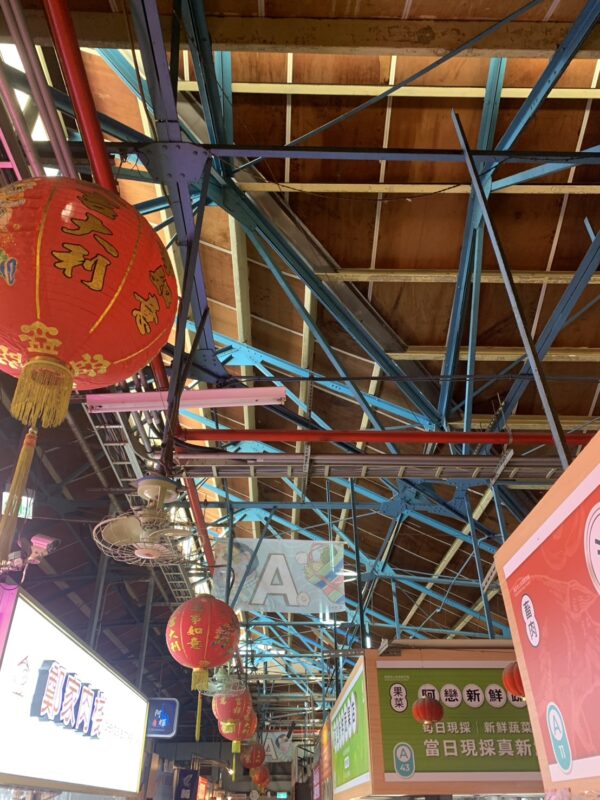
Tainan East Market, known as Dongcai, was built in 1909 in the 42nd year of Meiji, with a steel frame roof introduced during the Japanese colonial period. Solidly and honestly made, it retains parts of its historic form and stands with Ximen Market as a representative of Japanese-era market architecture.
|
ACT ONE
A century of lineage — why the rich people market? |
Dongcai’s lineage is remarkable. It was established in 1908, the 41st year of Meiji, one of the first generation of modern public markets, completed in the same period as Ximen Market. The Governor-General’s Office was then pursuing a market reform plan, gathering the open-air, disorderly stalls of the past into steel-framed buildings with roofs, drainage and order — extremely progressive urban governance for its day.
But what truly decided its fate wasgeography. Dongcai is ringed by important centres of worship such as the Tainan City God Temple and Dongyue Hall, and stands close to the early administrative centre around the prefectural hall and to the residences of the leading families. A century ago, those who shopped here were mostly officials’ wives, servants of gentry households and chefs from fine restaurants. When buyers are discerning, sellers cannot be careless.
Worth noting is thecolonial steel roofthat still stands. Steel was then an expensive import, and supporting a whole market on a steel frame was itself a display of national strength and urban standards. What it brought was not only solidity butventilation and light— the high structure lets heat rise, and natural circulation carries away the stuffiness and fishy air that plague traditional markets. That is why Dongcai still feels unlike an ordinary market today: its brightness and dryness are a gift handed down by the architectural wisdom of a century ago.
Among older locals another, earthier name for this area still circulates:the glutton square. In Taiwanese, the first part describes someone greedy for food, and the second means an open square. Together they describe this patch of ground where food has gathered since the Qing era, where nobody can resist moving from one stall to the next. From the people’s glutton square to the gentry’s rich people market, two entirely different names for the same ground show exactly how Dongcai’s appeal crosses class: it fed the passing labourer and waited on the exacting official’s wife alike.
|
⚖️ The trust economics of the fixed price
The point of the nickname has never been expensive but atop-tier filter. Stallholders here do not like to haggle, because they have absolute confidence in their goods; customers do not haggle either, because what they are buying is trust in a fixed price. In most markets, bargaining is a daily exchange of moves; at Dongcai, bargaining seems impolite — the assumption is that you already believe the price offered is the fairest one. That composure, free of negotiation, is the most expensive and most compellingsocial capitala century has accumulated.for the quality of daily life. |
A gentry’s day at table · the shopping route
Dongcai’s elegance lies in its sense of time. Follow this route once and what you carry home is not only ingredients but a whole day of composure.
| 07:00 |
Walk in · feel the architecture
Set out from 3 Door Hotel and walk about 10 minutes along Chenggong Road and Qingnian Road. Do not rush to buy: look up first at that colonial steel roof and the morning light falling through it. This is the most cultivated market opening in Tainan.
|
| 07:40 |
Settle your stomach · an emerald beginning
Go first to A-zhen spring rolls and watch the owner spread an emerald skin across the hot plate; then have a slice of A-mei old-style cake to warm your stomach. Shopping on an empty stomach leads to buying badly — Tainan people know this well.
|
| 08:30 |
★ The traveller’s best window
Buy knowledge · consult the craftspeople
The stalls are fullest and the craftspeople most free to talk. Tell the owner at the Zheng family butcher what you want to cook tonight and let him choose the cut; pick handmade fish balls at Mingzong. In this hour, what you buy is a consultancy you will not find elsewhere.
|
| 09:30 |
Finish with liquorice · walk back
Finally, order a chrysanthemum tea with liquorice root and astragalus from Auntie A-fen and drink it as you walk back to the hotel. Put your spoils in the fridge, and a Tainan afternoon begins from that composure.
|
|
ACT TWO
A textbook of taste — a tour of the classic stalls |
At Dongcai, every stall is a lesson in discernment. The following are the names the editor, after countless visits, most wants to underline for you.
| 01 |
A-zhen Spring Rolls| a visual surpriseThis may be the most beautiful spring roll skin in Tainan. Unlike the usual plain white, what A-zhen is praised for is that touch ofemerald greenin the spinach skin. Watching the owner sweep a green waltz across the hot plate and then wrap in dried tofu, shredded egg, cabbage and peanut sugar — this is not only street food but a clean, healthy, delightful piece of work. Insiders ask specifically for the green skin: it is A-zhen’s signature mark. |
| 02 |
A-mei Old-Style Cake| an olfactory temptationBefore you even reach the stall, thatrich, warm fragrance of egg and milkcatches your nose. The old-style cake here has no fancy cream decoration, only the purest flavour of its ingredients. Watching the owner cut a huge, airy, golden slab of cake is the boldest and gentlest afternoon tea in Tainan. Half plain and half chocolate is the regular’s standard answer. |
| 03 |
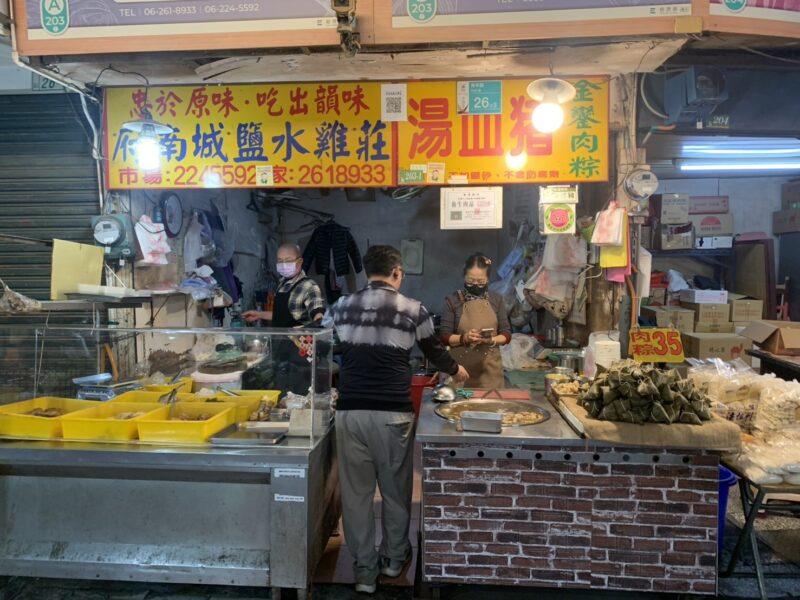
Jinluan Rice Dumplings| layers of textureWhat does a gentleman eat for brunch? Try a Jinluan rice dumpling. Firm glutinous rice drinks up the braising liquor and wraps around well-balanced braised pork and shiitake, dressed with Tainan’s characteristic sweet sauce and peanut powder. Add a bowl of clean, sweet pork blood soup and that balance offullness without greasinessis a microcosm of Tainan’s food aesthetics: rich, but knowing when to stop. Tainan dumplings belong to the southern boiled tradition, with soft grains and even flavour, a different philosophy from the northern steamed version with its distinct grains. One dumpling with soup is the most solid fuel there is before walking a market. |
| 04 |
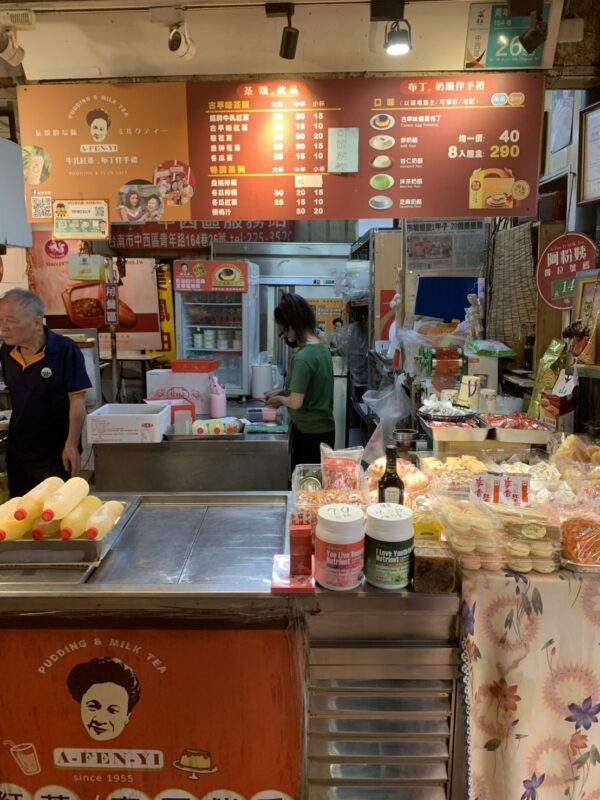
Auntie A-fen’s Milk Tea| a master of slow simmering, hidden in the marketWith changing times and the pandemic, Auntie A-fen now uses convenient paper cups, but the feeling of that first mouthful has not dimmed at all. The editor once happened to order achrysanthemum teaand realised that this woman is in fact a master of slow simmering, hidden away in a market. It is no ordinary sugar water. Beyond the clean fragrance of chrysanthemum there is a mellow depth — because inside areliquorice root and astragalus, to soothe the throat and build energy. On a hot Tainan afternoon this cup does more than quench thirst: it carries an older generation’s wisdom about nourishing the body through food. What you drink is not only a drink but Auntie A-fen’s care for every customer. |
|
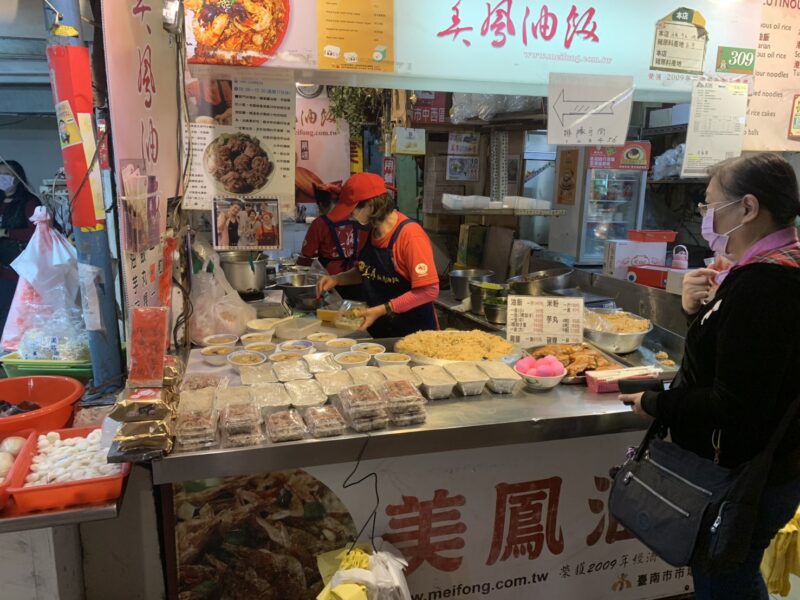
An editorial favourite:do not missMeifeng Oil Ricenext to Auntie A-fen — the oil rice, rice noodles and bowl pudding are all classics, flavours locals have known since childhood. |
| 05 |
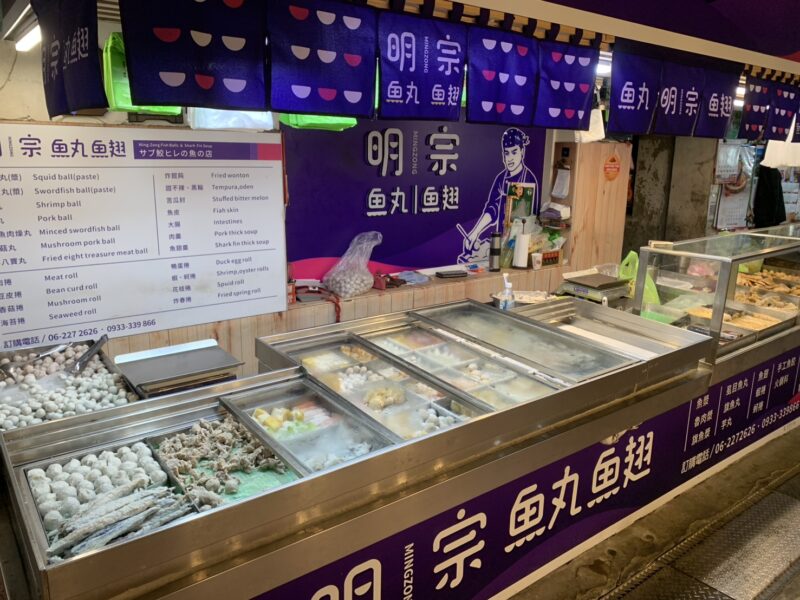
Mingzong Fish Balls| a craftsman of freshnessA celebrated name inside Dongcai: fresh, professional and faithful to traditional flavour, with a kind and straightforward owner. Mingzong’s handmade fish balls are excellent in soup or fried noodles, and are the editor’s own favourite stall — that firm, springy bite full of savour is craft that mass production can never imitate. |
|
ACT THREE
The art of shopping — a professional consultancy |
At the rich people market, what you buy is not only ingredients butknowledge. Every stallholder here is a skilled consultant on food.

|
🔪 Professional trust · a century-old shop
The Zheng Family ButcherAt this butcher, handed down for a century, the owner is more a food consultant. You need not know anything about meat; you need only say, “Tonight I want to make sweet and sour ribs.” He will select the cut precisely, cut it to size and even tell you how to marinate it for the deepest flavour. That bespoke service is a warmth no supermarket chiller can ever provide. The Zheng family’s story is so good that we wrote them a whole profile of their own —read The Zheng Family Butcher: one knife across three generations here, and see how second-generation owner Tsai Yu-lan turned a butcher’s shop into the kitchen strategist most trusted by the housewives of the old city. |

🍤 Meiyu Fried Items | a microcosm of the banquet
Unlike the rough-and-ready frying at Yamuliao, Meiyu offersrefinement. The eight-treasure balls and fried shrimp rolls here still keep the standard of early Tainan banquet cooking. Buy a few, arrange them on a plate, and you have a dish fit for company. This is the essence of the rich people market: what it sells is not fullness but dignity; what you carry home is not a meal but the confidence to entertain. For travellers, taking a few back to the hotel to go with a drink brings the gentry’s table of the old city straight into your room.
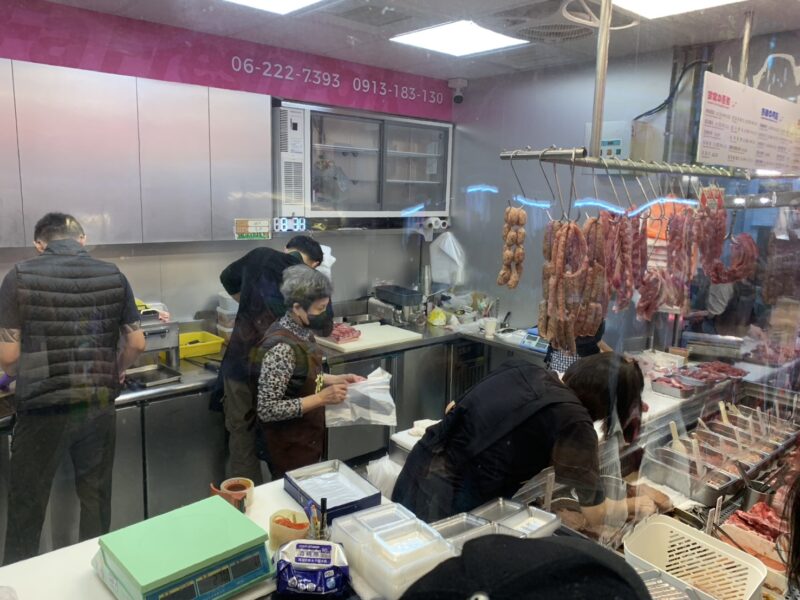
A bright, spotless specialist stall found only at Dongcai — the Jingfa butcher, where even a meat counter is kept immaculate.
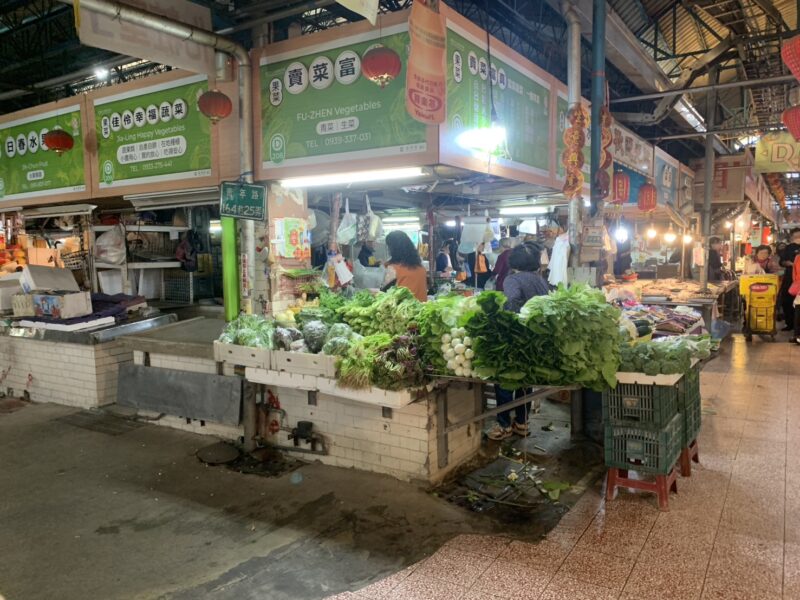
Even the vegetable stalls at Dongcai are arranged this beautifully; the reputation as an aristocratic market is thoroughly deserved.
|
ACT FOUR
Hidden details — the sources of flavour that are easy to miss |
🏺 Century-old grocers | the arsenal of Tainan sweetness
Walk to the back of the market and you will see several grocers and sauce stalls piled with jars and bottles. Please stop and look closely: there are little mountains of rock sugar, glossy black fermented beans, and dried shrimp and flatfish in every grade. These things are ordinary enough to overlook, and yet they are the true source of the depth in old-city cooking.
Remember the art of addition we described in Side Feature V: the Tainan spectrum of taste ?This is the arsenal of Tainan sweetness.It is precisely these unremarkable dried goods and sauces that give old-city cooking its inimitable layering and depth. Only those who know how to shop here have truly read Tainan’s code of flavour.
Many people think Tainan sweetness is simply added sugar, which is quite wrong. The real old-city flavour is built from the savour of dried flatfish, the depth of dried shrimp and the roundness of rock sugar, layered into a sweetness with real thickness — sugar is only the final stroke, and it is the invisible work beforehand that matters. Next time you taste that indescribable smoothness in a bowl of Tainan street food, do not doubt it: most likely it came from these unglamorous dried goods stalls at the back of Dongcai. They are easy to overlook, and they are the foundation of the whole city’s palate.
|
🗺️ A walking proposal · setting out from 3 Door Hotel
Ten minutes, from a good sleep into a century-old marketThis is one reason to put 3 Door Hotel on yourlist of recommended Tainan hotels— no car, no transfers; sleep well, and you can walk straight into a market with a century of history. The hotel sits at the lively heart of the West Central District, the ideal base for anyone who wants to explore the old city properly:a recommended stay in Tainan’s West Central District, with Chihkan Tower, Shennong Street and Dongcai Market all within walking distance. For travellers arriving by high-speed or conventional rail, it is only about ten minutes by car from Tainan Railway Station, so if you wantaccommodation near Tainan Stationthat also works for walking the old city, 3 Door offers close to the best of both.
|
|
EPILOGUE
Knowing how to eat means knowing how to live |
Walk Dongcai once and you will understand why Tainan people care so much about eating. Because here, food is not only for filling the stomach but a form ofrespect for living.for the quality of daily life.
The elegance here is not put on but grows from a century of commitment to quality, and from a trust between people that needs no words. What it teaches us is perhaps not only how to choose a good cut of meat or a good bunch of greens, but how toslow down and live a day properly.for the quality of daily life.
For you, staying at #3DoorHotel , Dongcai is the nearest time machine there is. Sleep well, walk over, buy a bag of tea and a slice of cake. Try slowing down like a Tainan gentleman and tasting this elegant, fixed-price daily life — that is the way of travelling in Tainan we most want to recommend.
|
Where to stay in Tainan · 3 Door Hotel Sleep well, and walk to Dongcai in the morning |
|
🎙 MARKET VOGUE PODCAST EP1 | A century of market lore: from the glutton square to the market of grand ladies, a legend of trust and good food Running time: 17 min 20 sec | Best listened to slowly with a cup of Auntie A-fen’s chrysanthemum tea 🍵 |
|
FAQ
Frequently asked questions |
| Q | Where is Dongcai Market, and what are its opening hours? |
| Dongcai lies near the junction of Qingnian Road and Dapu Street in the West Central District, about a 10-minute walk from 3 Door Hotel. Stalls open around five in the morning and most close between eleven and midday. We suggest visitingbetween seven and ten in the morning, when the range is fullest and the atmosphere liveliest. |
| Q | Why is Dongcai called the rich people market? |
| Founded in 1908, Dongcai sat beside the early administrative centre and the residences of Tainan’s leading families, and a century ago its main customers were officials’ wives and gentry servants. Stallholders were utterly confident in their quality and kept to fixed prices, so Tainan people came to nickname itthe rich people market.for the quality of daily life. |
| Q | Which stalls are essential at Dongcai Market? |
| The essential names include the emerald spinach skins ofA-zhen Spring Rolls, the golden freshly bakedA-mei Old-Style Cake, the pork blood soup pairing ofJinluan Rice Dumplings, the old-method simmering with liquorice root and astragalus atAuntie A-fen’s drinks, the century-old shop offering ingredient consultancy,The Zheng Family Butcher, the freshly handmadeMingzong Fish Balls, and the banquet standard ofMeiyu fried items.for the quality of daily life. |
| Q | How do I walk to Dongcai Market from 3 Door Hotel? |
| From 3 Door Hotel at No. 77 Chenggong Road, head north along Chenggong Road and turn into Qingnian Road; about10 minutes on footbrings you to the entrance. We suggest walking over early to enjoy the loveliest hour of an old-city market. |
| Q | Is Dongcai suitable for older relatives or children? |
| Very much so. Dongcai is spacious and bright with smooth circulation, and its high colonial steel frame gives good ventilation; the environment is clean and the stallholders welcoming. Compared with other traditional markets in Tainan, this is the mostcomfortable and unhurriedchoice for experiencing old-city market culture with children or older family members. |
| Q | How is Dongcai different from Ximen Market and Shuixian Temple Market? |
| All three are important historic markets, but their characters differ entirely. Shuixian Temple Market is fierce and bold, ruled by seafood; Ximen Market has a large footprint with fabric trading and street food side by side; and Dongcai is known for elegance, brightness and fixed prices, the aristocratic drawing room of the gentry. For the most unhurried market culture in Tainan, Dongcai is the first choice. |
| Q | How long does it take to walk Dongcai, and what route should I take? |
| Walking at leisure and eating as you go takes about an hour and a half to two hours. Enter from Qingnian Road for the Japanese steel-frame architecture, settle your stomach at the prepared-food stalls, shop at the Zheng family butcher and Jingfa butcher, then finish with Auntie A-fen’s chrysanthemum tea and walk back to 3 Door Hotel. |
| Q | Is there somewhere to stay within walking distance of Dongcai? |
| 3 Door Hotel stands at No. 77 Chenggong Road in the West Central District, about a 10-minute walk from Dongcai and close to Chihkan Tower and Shennong Street, with Tainan Railway Station about ten minutes away by car. Whether you are looking fora recommended stay in Tainan’s West Central District, or for somewhere convenient nearaccommodation near Tainan Station, the hotel is itself a space blending historic architecture with local culture, well suited to travellers who want to experience old-city market culture on foot. |
👜 The Market Vogue shopping guide | what to buy at Dongcai
|
|
✍️ From the editorial room
Writing this piece on Dongcai, the editor kept returning to one word: cultivation. A market can be cheap, lively and fierce, but to be elegant requires not decor but a kind of proportion, accumulated over a century and observed by buyer and seller alike. That is why we placed it at the head of Market Vogue — it reminds us that the greatest luxury in travel has never been how far you go, but whether you are able, one early morning, to slow down and live a day properly and with grace. Next time you come to Tainan, set your alarm a little earlier. |
|
NEXT ISSUE
Vol.2 | Shuixian Temple Market: the kitchen of TainanIf Dongcai is an elegant aristocratic drawing room, then our next stop, Shuixian Temple Market, is Tainan’s fiercest soul. A battle that begins at four in the morning, three hundred years of temple and market living together — we will take you to the source of flavour in the Five Canals. Look out for it. |
