
3 Door’s Traditional Market Walks
Yongle Market, a Three-Dimensional Textbook of Fucheng Street Food
◆
Travel in Tainan
◆
Tainan food
◆
Recommended stays in Tainan

[A 2026 preface for the younger generation] About that scent of flour that keeps going round on Instagram stories
If you open your phone and search for “Recommended stays in Tainan”, nine out of ten guides that come up will contain the words “Guohua Street”. But have you ever wondered why?
Why this street, which is not especially wide and does not even have that many stalls? Why this place called Yongle Market, which somehow seems to have no real boundary at all? Why does the younger generation, hooked after a single visit to Tainan, always treat this as the ritual ground without which “you have not really been to Tainan”?
The soul of this market is a story about contrast. Downstairs is a temple of street food that gourmets across Taiwan have raised to the status of legend: the sizzle of spring roll wrappers on the oil, the tremble of golden peanut powder in a stainless steel tray. Upstairs is another world folded up by time — old fabric shops, old tailors, old photographs, the air carrying machine oil and cotton thread, like walking into a Taiwanese film that has not yet been edited.
This time we invite you, the younger reader, to set aside the mindset of ticking off photo spots and, together with the editors of 3 Door, read Yongle Market as a three-dimensional textbook of Fucheng street food, steaming, oily, dusted with powder and fragrant with peanut. From the iron triangle to the secret world upstairs, from the first pot of minced pork sauce at dawn to the herbal tea after the stalls close at night — this article is your course schedule.
| 🎙 |
— MARKET VOGUE PODCAST —
EP3|Training the palate in Tainan street food: from the iron triangle of Yongle Market to the mutant pork tongue of the gua bao world!Length 16 min 56 sec | A live record of two hosts utterly conquered by the food storm of Guohua Street 🔥
|
To some places you go to travel; but coming to Tainan is more like undertaking a course of training for the palate. The moment the high-speed rail delivers you to Tainan Station, the moment a taxi sets you down at the corner of Guohua Street and Minzu Road, you are entirely surrounded by the mellow fragrance of minced pork sauce, the sweetness of peanut sugar, the steam of rice cake and the clang of iron spatulas on a hot plate — and you should understand that you have arrived at the final proving ground of this training.
Welcome to Yongle Market. There is no polite, gentle preamble here, only a direct assault of deliciousness. I am your guide at 3 Door Hotel. Together we have already walked the elegant composure of Dongcai Market and seen the raw, generous spirit of Shuixian Temple Market; today what we face is the most unabashed temple of food in this city. Every shop here is an independent chapter in the history of Tainan street food, and what is sold here is long since not simply food but answers that have already become legend.
(All photographs in this article come from the shops’ own Google business listings)

— Chapter 01
A cross-section of its origins
From the street cries of Shijingjiu to the pilgrimage road of Guohua Street
To understand the character of Yongle Market you must first go back to the childhood of this piece of ground. Older people in Tainan do not call it Yongle; they call it Shijingjiu, an old name taken from the stone rice-husking mortars of the Qing dynasty. This was the most important grain trading point in Fucheng; and since rice is the source of energy, it naturally drew countless labourers who needed to fill their stomachs, and with them the vegetable sellers, the butchers, the hardware and second-hand repairers and the itinerant traders, until at last there formed a teeming, mixed, vividly alive “thieves’ market”.
So every dish you eat at Yongle Market today has more behind it than simply being delicious. They are the final answers produced by more than a century of this land repeatedly iterating on a single logic: to serve the stomachs of ordinary people. Their flavour, their portion, their price and even their presentation are what survived a hundred-year knockout competition in the market — nothing that survived did so by luck.
And the boundary of this market is blurred. Or rather, it has no boundary at all. The market itself is like a star of enormous energy, its gravity rippling out along Guohua Street, Minzu Road and Hai’an Road, drawing countless shops towards it until at last there forms a galaxy of food living and prospering together. It is hard to say whether Guohua Street is great because of Yongle Market or Yongle Market is famous because of Guohua Street — they have long been joined at the blood, and together they make up a pilgrimage road that gourmets from all over Taiwan follow one after another.
Yongle Market has no boundary;
it is a star of powerful gravity
that has pulled the whole of Guohua Street towards it.
— Chapter 02
Stop one: the iron triangle
The opening poem of Guohua Street, the compulsory credits of Tainan street food
At Yongle Market getting lost is inevitable, but please do not panic. This map, drawn for you by the editors of 3 Door, is the best route, verified by countless gourmets with their time and their stomachs. Let us begin our studies with the most classic of all, the iron triangle — these three shops are the three names that appear most often in Instagram stories about Tainan food, and they are the opening poem you absolutely must not miss.
◆ Fushenghao Bowl Cake|A bowl of deep brown pride
Please first set aside everything you assume about white bowl cake. Fushenghao’s bowl cake is a deep, settled brown, the colour of pure non-glutinous rice batter steamed together with a secret minced pork sauce inherited through three generations. Once steamed, the shop cuts it a few times in the bowl with a bamboo knife and pours over a special thick sauce and minced pork — and in one mouthful the fragrance of the rice, the savoury sweetness of the pork sauce and the depth of the thick sauce interweave.
Even now you can see the third-generation successor sitting in the shop himself, watching every bowl that leaves with a sharp eye. For you, the younger reader, this bowl of rice cake is moving not only because it tastes good but because it lets you see with your own eyes how a family trade is caught and carried on, one generation after another.
| Shop | Fushenghao Bowl Cake |
| Must order | Bowl cake and fish thick soup (most often taken together) |
| Location | No. 8, Lane 333, Section 2, Ximen Road, West Central District, Tainan City |
| Note | We suggest going in the morning; they close when sold out, and there is often a 15–25 minute queue |
◆ Jinde Spring Rolls|A perfect concerto of sweet and savoury
Jinde’s spring rolls are an art of accommodation. Even when the queue has already wrapped around the corner, the owner’s hands keep their steady rhythm as she rolls — muscle memory built from countless mornings, so that every roll is almost identical in thickness and tightness.
Into that wrapper, griddled fresh each day, thin enough to let light through yet remarkably tough, she fits more than ten ingredients in harmony: cabbage, dried tofu, lima beans, pork, shrimp, sausage and more. The crucial touch is the finishing stroke before it is closed — that spoonful of unstintingly generous sugar mixed with peanut powder.
For many friends from the north visiting for the first time, that spoonful of sugar produces two kinds of reaction on Instagram: those who find it too sweet, and those who say this is exactly what Tainan is. But the editorial team would like to tell you that this is not a question of seasoning but a question of culture.
Sweetness in Tainan has never been simply seasoning; it is a display of abundance and warmth. In the days when sugar cost more than rice, adding sugar meant “I am giving you the best I have”. Understand that layer of meaning and what you are eating is not merely a spring roll but a whole stretch of Taiwan’s culinary history.
| Shop | Jinde Spring Rolls |
| Must order | The original spring roll (two per portion) |
| Location | No. 19, Section 3, Minzu Road, West Central District, Tainan City |
| Note | There is a queue but it moves quickly; you can ask for less sugar and less peanut |
◆ A-Song Gua Bao|A gentle subversion

If you have eaten gua bao in Taipei or Taichung, then on arriving at Yongle Market please put that impression away for a moment. A-Song’s gua bao is a gentle subversion of tradition. Holding one fresh from the steamer, you feel the warmth and softness of the bun in your palm — a texture that recalls the warmth of a grandmother’s hand.
There is no fatty pork belly here and no heavily pickled mustard greens. In their place are slices of lean meat, the classic “tiger bites pig”, or, for those in the know, the wonderfully textured pork tongue. Yes, you read that correctly: pork tongue. The combination of gua bao and pork tongue will make you hesitate at first sight, marvel at the first bite, and by the second bite begin to suspect that everything you ate before was a counterfeit gua bao.
And what wraps all of this is not the usual peanut powder but a faintly sour, milky-white sauce carrying the fragrance of peanut. The acidity of this sauce is judged exactly right, tying together the softness of the tongue, the firmness of the lean meat and the sweetness of the bun.
| Shop | A-Song Gua Bao |
| Must order | Pork tongue gua bao (limited quantity, until sold out) |
| Location | No. 181, Section 3, Guohua Street, West Central District, Tainan City |
| Note | For the pork tongue we suggest arriving early; gourmets also recommend the mixed one |
— Chapter 03
Stop two: deep inside the market
A hall for the advanced — as the noise settles, the flavours grow deeper
Once you have finished the iron triangle, take a deep breath and switch yourself from “photo-spot mode” to “wandering mode”. Next we go into the interior of Yongle Market, where the noise settles a little and the stalls become smaller, denser and closer to the everyday life of the locals — but where the flavours are often deeper still.
◆ Xiu’an Shoulder-Pole Tofu Pudding|The philosophy of time in a pot of syrup

Beginning with the cries of the first generation carrying the pudding through the streets on a shoulder pole, Xiu’an’s tofu pudding has carried a philosophy of time. The pudding itself is tender, but its real soul is that pot of syrup simmered over charcoal by traditional methods. Its sweetness is not blunt but layered — caramel at the front, the roundness of sugar in the middle, and at the end the faintest trace of charcoal smoke.
In summer they make a shaved-ice version, in winter a hot one. For you, the younger reader, the most captivating thing about this bowl is that it lets you see with your own eyes how a century-old name has lived itself into legend by the most unremarkable of means. No excessive packaging, no photogenic cup, only that white pudding trembling faintly in front of you.
◆ Shijingjiu Oyster Omelette|A miracle on the hot plate

The oyster omelette of Tainan carries a pride of its own. The oysters at Shijingjiu come straight from the beds each day, plump, fresh and almost free of any fishy smell. The shop’s own proportion of batter creates a miraculous texture on the searing plate — crisp outside, springy within, and crunchy underneath, three textures at once.
The sauce poured over it is the sweet-and-spicy Tainan style — yes, the sweet chilli sauce here is sweeter than in the north, but it also has more layers. Add the fragrance of a freshly cracked egg and the salt of the sea bursting from the oysters, and this dish you have eaten all your life will make you understand once again what the word fresh really means.
◆ Qiu Family Squid Rice Noodles|A bowl of clear freshness
If you still have an appetite, walk a few steps north along Guohua Street: Qiu Family Squid Rice Noodles is another compulsory credit. A bowl of broth so clear you can see the bottom, a few neatly cut pieces of squid, and fine rice noodles. There is no complicated seasoning in the broth, only the pure sweetness drawn out by the squid and the dried bonito.
This seemingly ordinary bowl of noodle soup is the finest demonstration of the Tainan aesthetic of “governing the complex through the simple” — when the ingredients are fresh enough, seasoning should step back. For a generation spoiled by influencer cooking, this bowl of soup offers a gentle reset of the palate.
— Chapter 04
Stop three: the aesthetics of cutting through
Between assaults on the palate, learn the compulsory lesson of the reset
At Yongle Market, after three shops of the iron triangle plus two or three stalls deeper inside, your palate will begin to protest. At that point you must learn one thing: how to cut through the richness.
The people of Tainan have a system of their own for this. The first answer is Shuixian Temple herbal tea — a deep green liquid simmered from more than ten herbs; drink it and a coolness travels straight from your throat to your chest. It is the best companion for restoring your strength and going into the next battle.
The second answer is Yifeng Winter Melon Tea. Winter melon tea in Tainan is not casually boiled sugar water but is simmered from whole blocks of winter melon sugar — sweet with real weight, yet never cloying; cold and easy to drink, washing away in an instant all the oil and salt in your mouth.
The third answer is Jiangshuihao Eight Treasure Ice, or, beside it, Sun Brand Ice. The moment you put a spoon of red bean, a spoon of peanut, a spoon of aiyu jelly and a spoon of ice into your mouth, you will understand why people in Tainan always say, “after the savoury you must have the sweet; only then is it balanced”.
In Tainan, cutting through the richness is not a supporting role;
it is a compulsory subject.
Fail to learn it and you will never eat your way through this city.
— Chapter 05
Stop four: the secret world upstairs
Look up and you will see another world folded up by time

After being utterly conquered by the food, if you still have any strength left, do look up at that unremarkable staircase. Climb it and you enter an entirely different world..
Hidden there is a once-flourishing labyrinth of fabric. Old fabric shops, experienced tailors, bolts of cloth in every colour stacked to the ceiling, the air drifting with cotton thread and machine oil. This is a historical relic of the golden age of Tainan’s fabric wholesale trade — before fast fashion took over Taiwan, the bridal shops, costume makers and qipao artisans of the whole south came here to buy.
You will see old sewing machines one after another, bolts of patterns long out of production, and a few women sitting on low stools in reading glasses working the treadle. They will not greet you first, but if you ask, they will gladly tell you which bolt came in from Thailand recently and which is the last length of a vintage Japanese floral print.
This scene is perfect for you. It is not on the popular recommendations in Google reviews, but it will return to you every time you later find yourself missing Tainan. If you want to take photographs, please ask politely first; if you want to buy cloth, spend a little time talking with the owner — it is a conversation you will certainly want to have again.
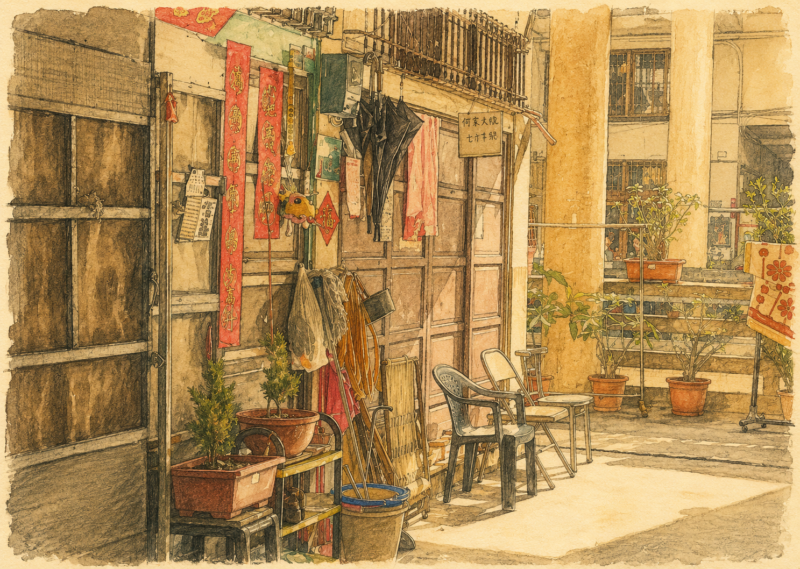
“Noise downstairs, quiet upstairs” — this powerful aesthetic of contrast is the most captivating and the most profound thing about Yongle Market. It tells you that a good market has never been merely a place where things are sold; it is a time capsule a city has kept for itself..
— Editor’s Field Notes
The editor’s private notes
| 01 |
Working as a team is the only right answerIf you have come with friends, do make sure to attack separately and share at a fixed point. One person queues at each shop, and once you have everything you share the feast on a street corner. This is the supreme principle for conquering Yongle Market — come alone and your stomach holds two shops, but come as three and you unlock five at once. |
| 02 |
Queueing is a kind of sociologyAt Yongle Market, queueing is not merely waiting; it is a ritual, a collective tribute to traditional flavour. The people in the line have come from Taipei, from Kaohsiung, and from Hong Kong and Tokyo too — in those twenty minutes you will hear the most honest commentary on Tainan in the entire Chinese-speaking world. |
| 03 |
Cutting through the richness is a compulsory subjectIn this high-density bombardment of food, a timely reset of the palate is crucial. A cup of Shuixian Temple herbal tea from the corner of the lane sends a coolness straight from your throat to your chest — the best companion for restoring your strength and going into the next battle. |
| 04 |
Do not forget the view upstairsPlease go up to the market’s second floor. Another world is hidden there — old fabric shops and experienced tailors, the air drifting with cloth and machine oil. It will not appear in the popular guides, but it will become the thing you boast about to friends once you are home. |
| 05 |
Choose the right place to stay and you are halfway thereIt is a ten-minute walk from 3 Door Hotel to Yongle Market — a distance that lets you sleep well, rise and stroll over slowly, and after eating walk gracefully back for an afternoon nap. This is exactly why the location of Yongle Market directly determines the order of your Recommended stays in Tainan list. |
|
— TAINAN STAY RECOMMENDATION —
Recommended stay in Tainan|A Fucheng base within walking distance of Yongle Market3 Door Hotel is at No. 77, Chenggong Road, within walking distance of Guohua Street, Yongle Market, Shennong Street, Shuixian Temple Market and the Confucius Temple district — the best possible position for “setting down your luggage and starting to eat”. |
Book a room now |
— Chapter 06
Stop five: a guide for the younger generation
A walking guide to Yongle Market for the Instagram generation
If this is your first time in Tainan and you belong to the generation that asks “is it recommended on Instagram?” before anything else, here are several practical suggestions the editorial team has gathered for making the fewest mistakes, to save you wasted steps and bring you more of the right flavours.
◆ Timing strategy: leaving at eight in the morning is the cleverest
The best time to visit Yongle Market is between 8:30 and 10:30 in the morning. At this hour: (1) most stalls have just opened and the ingredients are freshest; (2) the queues have not yet exploded; (3) the weather is cool, so you will not be drenched in sweat as you eat and walk; (4) the light for photographs is at its best, with side light through the arcades falling on the stalls in a cinematic way.
If you sleep later, arriving after 11:00 is also fine, but be prepared mentally to queue for an hour — especially at weekends. The least recommended time is between 12:00 and 13:30, when the whole of Guohua Street becomes too crowded to move.
◆ Equipment strategy: travelling light is king
Please wear comfortable shoes. The density of the crowds on Guohua Street will make you regret every decision to wear heels for a photograph. A small cross-body bag is enough, and keep both hands free — because you will be carrying plastic bags, paper bags, drinks and one freshly bought spring roll after another.
One small reminder: please bring a handkerchief or wet wipes. Tainan street food comes with plenty of sauce, and after one round your hands will need cleaning rather more than you expect.
◆ Photography strategy: eat first, photograph after — the eternal rule
Many stallholders dislike being photographed repeatedly, because it blocks the flow of the queue. If you want to photograph the food, first step back to the side of the stall or the arcade opposite and find a corner where you are not in the way. When photographing people, ask first; older people in Tainan will usually nod, and some will even chat with you.
The editorial team’s most recommended vantage points are: (1) the arcade opposite A-Song Gua Bao, from which you can capture the whole sign along with the queue; (2) diagonally opposite Fushenghao, where you can photograph the old handwritten menu; (3) the top of the staircase on the second floor, where light falls from the skylight and the quality is superb.
◆ Budget strategy: NT$500 a head and you will eat until you are full
The good thing about Yongle Market is that it is cheap. Prepare NT$500 a head and it is already enough for the whole iron triangle plus one or two of the deeper recommendations, with two drinks to cut through the richness. If your budget is looser, set aside another NT$200 for gifts to take home — a block of Yifeng winter melon sugar, a packet of Shuixian Temple herbal tea, or handmade preserved fruit from one of the stalls on Guohua Street.
— Chapter 07
Stop six: the walking route
Setting out from 3 Door and eating your way through a Fucheng morning
The walking route the editorial team most recommends is arranged like this — it is unhurried yet unlocks the essence of three markets and one old street in a single go, and the whole walk is under 4 kilometres:
| 08:00 | Set out from 3 Door Hotel, warming the stomach first with a hand-poured coffee in the lobby |
| 08:30 | Walk to Yongle Market and take Fushenghao Bowl Cake first (at the quietest hour) |
| 09:00 | Jinde Spring Rolls; take two away and share them on the street corner |
| 09:30 | A-Song Gua Bao with pork tongue; take it to the arcade opposite to eat |
| 10:00 | Into the depths of the market: Shijingjiu Oyster Omelette and Xiu’an Shoulder-Pole Tofu Pudding |
| 10:30 | Time to cut through: Shuixian Temple herbal tea or Yifeng winter melon tea |
| 11:00 | Up to the old fabric shops on the second floor and feel the gap in time |
| 11:30 | Follow Guohua Street south and link up with the old-street character of Shennong Street |
| 12:00 | Back to 3 Door Hotel for an afternoon nap, then set out again for the Confucius Temple and Hayashi Department Store |
The core logic of this route is to give the stomach time to digest, the eyes time to appreciate and the feet time to rest. The worst thing you can do when travelling in Tainan is to hurry — because the essence of this city is always hidden in the moment you slow down.
— Chapter 08
Coda
Graduate with a sense of satisfaction and take the flavour code of Fucheng home

Walking out of Yongle Market, you will feel as though you have completed a demanding but richly rewarding course of training. What you carry away is not only fullness but a deep understanding of Tainan’s flavours, a flavour code that lets you resonate with the locals..
The shops here have together created a perfect street food universe. In this universe the soup of the gua bao can accompany a spring roll, the richness of the bowl cake can be cut with herbal tea, and the freshness of the oyster omelette can be rounded off with tofu pudding. Diners can combine freely and create their own perfect set — and this is exactly the most captivating flexibility and freedom of Tainan street food..
And for you, who give priority when choosing a Recommended stays in Tainan list to whether you can walk to Yongle Market, 3 Door Hotel is the ideal base for this journey of culinary training. It is only a few minutes’ stroll from the hotel; once full, walk gracefully back for a nap, and in the afternoon carry on with the second half at the Confucius Temple, Hayashi Department Store and Shennong Street — this is the highest form of enjoying Tainan.
Set down your bags and get ready. This thick, steaming textbook of Fucheng street food, oily and dusted with powder and fragrant with peanut, is waiting for you to turn its first page with your own hands.
Frequently asked questions Q&A
Where is Yongle Market? How is it related to Guohua Street?
A
Yongle Market is in the West Central District of Tainan, near the corner of Guohua Street and Minzu Road, about ten minutes’ walk from 3 Door Hotel. The market itself and Guohua Street have long been joined at the blood and together make up the densest food pilgrimage route in Tainan. Their boundaries are blurred; you could say Guohua Street is great because of Yongle Market, and Yongle Market is famous because of Guohua Street.
Which three shops make up the iron triangle of Yongle Market?
A
The essential iron triangle is Fushenghao Bowl Cake, with its deep brown secret minced pork sauce; Jinde Spring Rolls, which wraps more than ten ingredients in a wrapper thin enough to let light through; and A-Song Gua Bao, with pork tongue and its own milky-white sauce. Each of the three represents a different dimension of Tainan street food, and together they are the compulsory credits for a first visit.
What is on the second floor of Yongle Market? Is it worth going?
A
The second floor of Yongle Market still holds old fabric shops and tailors, with the scent of cloth and machine oil in the air — a historical relic of the golden age of Tainan’s fabric wholesale trade. The aesthetic of contrast, “noise downstairs, quiet upstairs”, is an experience travellers who like to go deep should not miss, and a hidden attraction you will not find anywhere in Google reviews.
Are there any tricks to conquering Yongle Market?
A
The supreme principle is “attack separately and share at a fixed point”: each of you queues at one shop and you share on the street corner once you have everything. When it feels too rich, have a cup of Shuixian Temple herbal tea to reset the palate. We suggest arriving between 8:30 and 10:30 in the morning to avoid the afternoon crowds; the light is also at its most beautiful for photographs.
How do I walk to Yongle Market from 3 Door Hotel?
A
It is From 3 Door Hotel (No. 77, Chenggong Road, West Central District, Tainan City) it is about ten minutes’ walk to Yongle Market. We suggest setting out in the morning; after eating, extend the walk to Shennong Street and Shuixian Temple Market to form a complete Wutiaogang walking route, then return to the hotel to rest in the afternoon before starting on the Confucius Temple and Hayashi Department Store.
Is it strange for a young person to go to Yongle Market alone?
A
Not at all. Yongle Market has always been a mixed and varied place, and a young person travelling alone can in fact concentrate more fully on each dish. The only drawback is that you have only one stomach — so if you are coming alone we suggest the strategy of “half portions” or “taking food away and eating it in stages”, splitting the day into a morning and a midday assault, which works best.
Are there vegetarian options at Yongle Market?
A
There are, but fewer. You might consider Jinde Spring Rolls (please ask for no meat and no shrimp), Xiu’an Shoulder-Pole Tofu Pudding, and the herbal tea and winter melon tea drinks. If you are a strict vegetarian, the editorial team suggests planning alongside other well-known vegetarian places in Tainan (such as Shuangquan Black Tea or the vegetarian district on Kaiyuan Road) for a fuller experience.
Market Vogue Vol.4|Ximen Market: a fashion specimen of the Japanese colonial era and a site of renewal by the young
In the next issue we walk into Ximen Market, whose historic buildings have just been restored, to see how an old market shines again in the hands of Generation Z.
3 Door Market Walks · the full series
📖 Series overview
🗺️ Walking guide
EP1 Dongcai Market
EP2 Shuixian Temple
EP3 Yongle Market
EP4 Ximen Market
EP5 Yamuliao
Extra I The breakfast war
Extra II The alchemy of sweetness
Extra III Off-duty gourmets
Extra IV The soundscape
Extra V The flavour spectrum
#YongleMarket
#GuohuaStreetFood
#TainanStreetFood
#FushenghaoBowlCake
#JindeSpringRolls
#ASongGuaBao
#TainanInDepth
#3DoorHotel
#MarketVogue
Stay at 3 Door and make Yongle Market the corner of your own street
Guohua Street, Shennong Street, Shuixian Temple Market and the Confucius Temple district are all within walking distance. The most in-depth walking life in Tainan begins at No. 77, Chenggong Road.
