
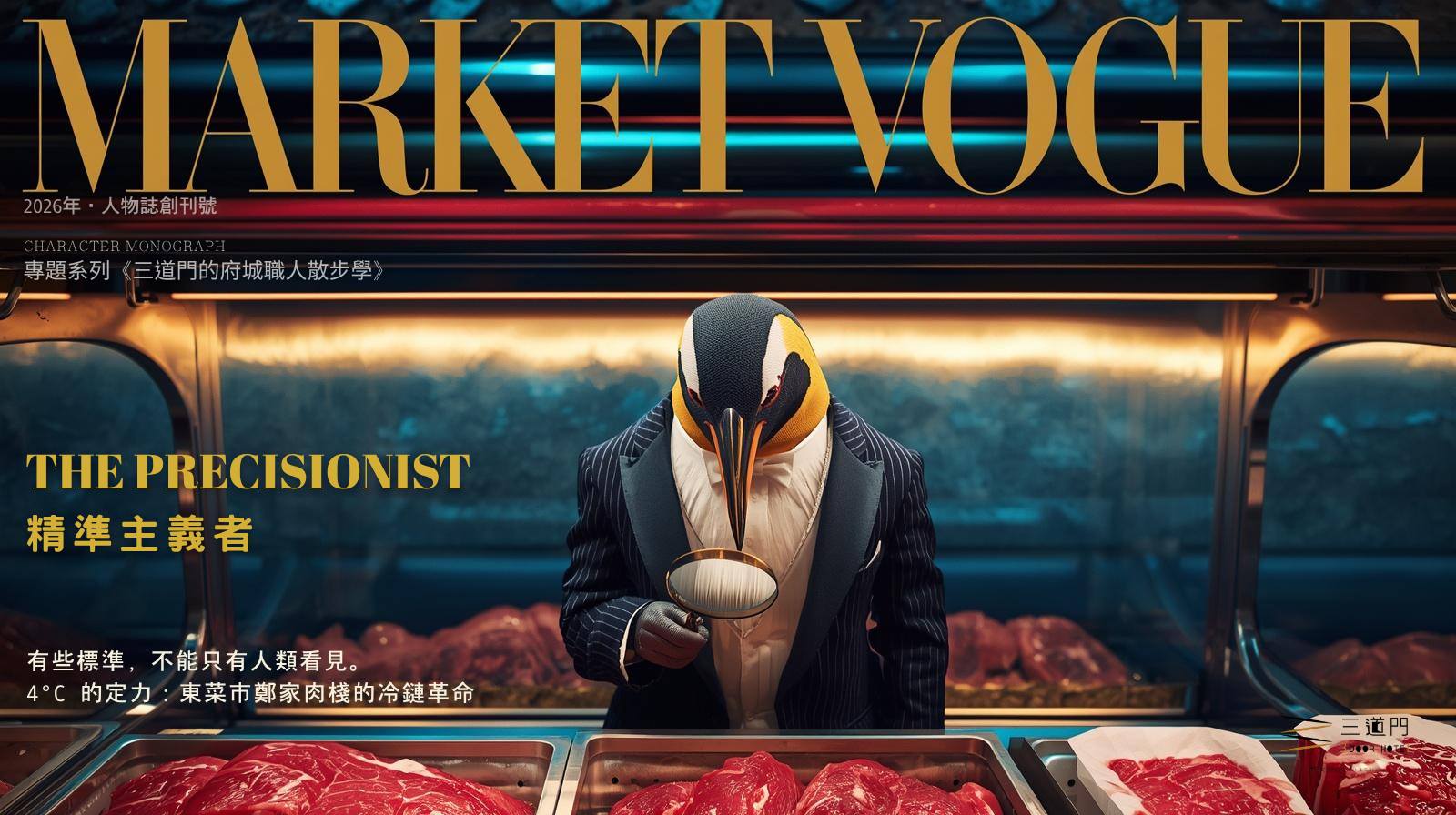
3 Door Hotel’s craftsman walks in old Tainan
Dongcaishi Market: Cheng’s Butchery
A century curated by a precisionist
From a cold-chain revolution thirty years ago to the counselling behind the counter:
decoding the highest standard of taste in the old city
Written by the editor-in-chief, 3 Door Hotel
Why do we write about craftspeople?
If the market is this city’s stomach, craftspeople are the flesh and blood moving through it.
Over the past year of Market Vogue’s urban collecting project, we have taken travellers into five traditional markets in Tainan, writing about architecture, about sound, about taste. But as we wrote, we found that the most compelling thing was rarely the fabric of the place; it was the people who have stood at the same stall for three generations – protecting not just a business but an almost obsessive commitment to a standard.
In 2026, an age governed by efficiency and algorithms, that obsession is extraordinarily precious and close to endangered.
For the first issue of our craftsman series we returned to the market Tainan people call the rich people’s market and found the shop that has redefined how high a traditional butcher can aim:Cheng’s Butchery. This is not only a story about pork; it is a long argument about composure – about people who, in an age that has lost its patience, still choose the slowest way to do everything as well as it can be done.
|
|
Market Vogue Podcast · Character Series Ep.01 Cheng’s Butchery: the knife that has not changed in thirty years |
Above Jiuling:
the genes of refinement at the top of the old city
To understand the unquestionable precision at Cheng’s, you first have to understand Tainan’s terrain.
The old city is not flat but made of seven low hills. In the Qing period, the highest of them – closest to the centre of power – was called Jiuling, and the prefectural offices stood on its flank. The finest talent and wealth of the old city gathered on Jiuling, and in 1908 Dongcaishi Market came into being. From the first day, its customers were not ordinary people.
The first generation of the Cheng family set their family rule within that air of gentility. In such a social stratum, a piece of pork was not only food: it was the face of a dinner, and an insistence on order in an official’s household. You could not serve second-rate meat to people with standards for everything – they could taste it.
Once planted, that gene is hard to dilute. Three generations on, the Cheng standard is exactly as it was. This is not stubbornness but respect for the customer: if you have come to me, you deserve the best.
TIMELINE · A century of composure
| 1908 | Dongcaishi Market formally opens. On the high ground of Jiuling, serving senior officials of the Qing and Japanese colonial periods, it sets a gentry tone of high quality and no haggling. The most exacting people in the old city now had a fixed place to shop. |
| 1920s | The first generation of the Cheng family arrives. Beside the centre of power, they establish a family brand gene of never selling second-rate goods. From the first day, their stall was not a place for haggling. |
| 1990s | The third generation, Cheng Chih-hsien, begins the cold-chain revolution. While traditional markets across Taiwan were still in the age of ice, he installs an all-stainless refrigerated display system – regarded as an aberration by his peers and as a standard by his customers. |
| 2026 | 3 Door Hotel and Cheng’s Butchery find a shared craftsman’s spirit, turning composure into a deeper kind of walk for travellers, so that more people can meet this century-old standard on a morning at Dongcaishi. |
VOL. II / The loneliness of the cold chain
The traitor of thirty years ago:
a cold revolution behind glass
Thirty-odd years ago, Tainan’s traditional markets were in the grip of a faith in freshly slaughtered, room-temperature meat. In the everyday logic of the time, good pork had to be warm and had to be pressable by a customer’s fingertips. That ritual of direct contact was taken as the final confirmation of freshness.
Cheng Chih-hsien, the third-generation owner, made a commercial gamble his neighbours saw as a betrayal of tradition: he installed one of the earliestfully refrigerated stainless steel display casesin Tainan. Glass and cold air, in that era, were a direct challenge to market culture.
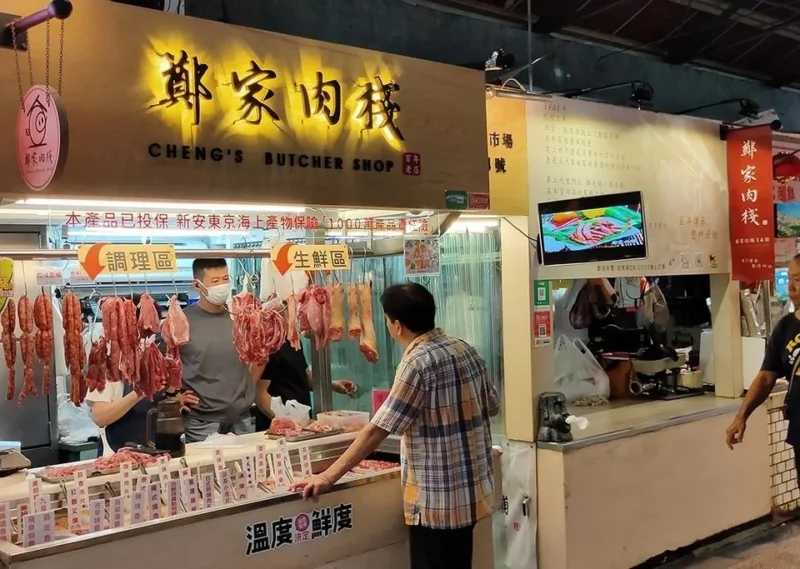
Cheng’s Butchery, Dongcaishi · the cold-chain revolution in Tainan’s traditional markets. Image: Cheng’s Butchery, Google owner’s selected photo
“The neighbours all laughed at us behind our backs and said we were mad. If the meat is shut in a glass case, how do customers touch it? And if they can’t touch it, how will they believe it’s fresh?”
– Cheng Chih-hsien, from our interview
But Cheng knew one thing: the moment meat leaves its ideal constant 4C, its cell structure begins to break down and its flavour begins to go. In the markets of that era, pork delivered in the morning had often begun to change quietly before midday in the southern heat – colour, smell and elasticity all telling anyone who knew that it was no longer at its best.
Cheng chose the loneliest path. Under the sceptical gaze of the whole market, he installed that stainless steel system with its cold white light. Some long-standing customers were uncomfortable at first and went next door. But time is the most honest judge: meat still red and full in the summer heat, pork chops that did not weep and discolour three hours later, eventually brought the most demanding regulars at Dongcaishi back – and they have never left since.
That stainless space with its cold white light filtered out the dust of the market, sealed in the flavour and eventually became the most unshakeablecircle of trustat Dongcaishi – the meat behind the glass became the highest measure of quality in the old city.
Every cut
is a precise prediction of where the cooking ends
At Cheng’s, every piece of meat has its own physical purpose. The craftsman’s task is to see, at the instant the knife goes in, the final form this piece will take in the pan – a precise prediction built on a deep understanding of muscle fibre, fat distribution and collagen density.

“Every cut exists so that the ingredient can take its final place on the table.”
(Image source: Agriculture Media)
Take pork shoulder. To ensure the slices stay silky after just 30 seconds in a searing wok, Mr Cheng cuts according to fibre direction based on the meat’s elasticity. The fat in shoulder runs in an irregular marbling, and the direction of those veins determines how evenly heat travels – cut the wrong way and even the finest ingredient shrinks to rubber in the heat.
More striking still is how they handle cartilage ribs, the restorative cut favoured by Dongcaishi’s well-to-do customers. The Cheng family patiently remove the lymph nodes and fascia around the cartilage. That step is often skipped in traditional markets because it is slow and laborious, and because the meat weighs less afterwards, which costs the seller money. The Cheng logic is one sentence: every gram you take home should be worth what you paid.
This obsession with purity means Cheng’s meat has already completed a visual and gustatory rehearsal before it reaches the pan. Open the packaging and you see no excess blood and no lymph left in place – only a clean, full cross-section with red and white clearly defined. That is the real measure of a craftsman: not lowering the standard where the customer cannot see.
VOL. IV / Counselling behind the counter
The meat counsellor:
a double diagnosis of eye and intention
At Cheng’s, the proprietor who talks to customers is not a cashier but something closer to adietary adviser, combining nutritionist, cooking coach and counsellor. There is none of the calling-out common in traditional markets; instead there is a low voice more like a consulting room.
She does not only listen to what you want; she watches your colour, the day’s humidity, even the turning of the seasons. Say “my mother hasn’t been well, I’d like to make a restorative soup” and she does not reach for a cut. She asks first: how old is she? What is troubling her? How is her appetite? Is her digestion sensitive?
In an age of AI that strips the person out, they have held on to one person genuinely seeing another. You carry pork home, but you also carry home the memory of being taken seriously – and that feeling often heals more than the food itself.

Cheng’s Butchery · three generations of one mind, unchanged in a century (Image source: Agriculture Media)
The butcher’s lecture in dietary consultation
| What you are cooking | Suggested cut | The Cheng family’s tip |
|---|---|---|
| A restorative broth for a child | Selected cartilage ribs | Lymph nodes and fatty membranes removed thoroughly, leaving only pure marrow essence. The broth is clear rather than heating, so children can drink it without discomfort. |
| A quick family stir-fry | Shoulder cut across the grain | The craftsman cuts across the grain for you, breaking the tough fibres. Thirty seconds in the pan is enough for tenderness, with no toughening and no shrinkage. |
| Nourishment for older family members | Tenderloin | The finest-textured cut on the animal, with no fat to weigh it down. Best for long, gentle simmering, giving a clear broth that never cloys. |
| A main dish for a celebration | Pork belly | Cheng’s belly is chosen for the ratio of fat to lean: clearly layered and never too fatty, suited to red braising or steamed pork with preserved greens, and a credit to any table. |
VOL. V / The alchemy of taste
Cured pork and steamed rice-powder pork:
an aesthetic of time, sealed in
On the tables of the old city’s gentry, Cheng’s cured pork has never been merely a dish. Behind it lies an underrated Tainan version of charcuterie, and the secret is the traditional red yeast paste the family insists on and a five-spice ratio handed down through three generations.
This is not chemical seasoning but a slow, light ageing. The proportions of the five-spice blend are adjusted for each batch according to the season’s humidity and temperature. Summer and winter in Tainan affect how quickly spices penetrate in entirely different ways: in summer the flavour goes in fast but can overshoot; in winter ageing is slower but the layers run deeper. Vacuum packing in a supermarket can never handle that detail, because what it needs is not a machine but a practised nose that smells and feels it every day.
“Well-cured meat should not mask the smell of the meat
but awaken the century of resonance sleeping in the fat.”
When you pan-fry this meat, the fat that renders out carries a woody fragrance – time’s second soul given to the pork. The fat melts in the heat and meets the fermented aroma of the red yeast, forming that lightly caramelised layer in the base of the pan. That aroma is hard to find in exactly the same form anywhere but Cheng’s.
The steamed rice-powder pork, meanwhile, answers the modern problem of wanting to eat well without the time to do it. The craftsman takes on all the laborious curing so that you can put something refined on the table with no apparent effort. Lift the lid of the steamer and the rice powder has drunk up the juices – soft but not collapsed, rich but not heavy.
VOL. VI / A contract of trust
Why the name Cheng
is worth more than a certification mark
At Dongcaishi Market there is something more solid than any certification mark:the personal guarantee of an individual’s credit. Regulars here do not even look at the scales, because every gram is underwritten by a century of reputation. You do not need to compare three shops, study origin labels or check certificates – you only need to walk up to the glass case, say what you want today, and trust those hands.
In an age of misinformation and constant food safety worries, that kind of trust is remarkably scarce. You can buy meat that passes every certification, but you cannot buy someone willing to take responsibility for your health. What the Cheng family protect is the most basic promise between people: I choose the best for you, because your family’s wellbeing matters.
Real luxury is an understanding between supplier and customer that needs no questioning. When you buy Cheng’s meat, what you are really buying is this city’s scarcest resource:the right to feel safe– because how many things in this world can you put into the mouth of someone you love without a shred of doubt?
Neighborhood Guide
The elegant satellites of Dongcaishi:
a collective evolution of standards
No shop here is an island.
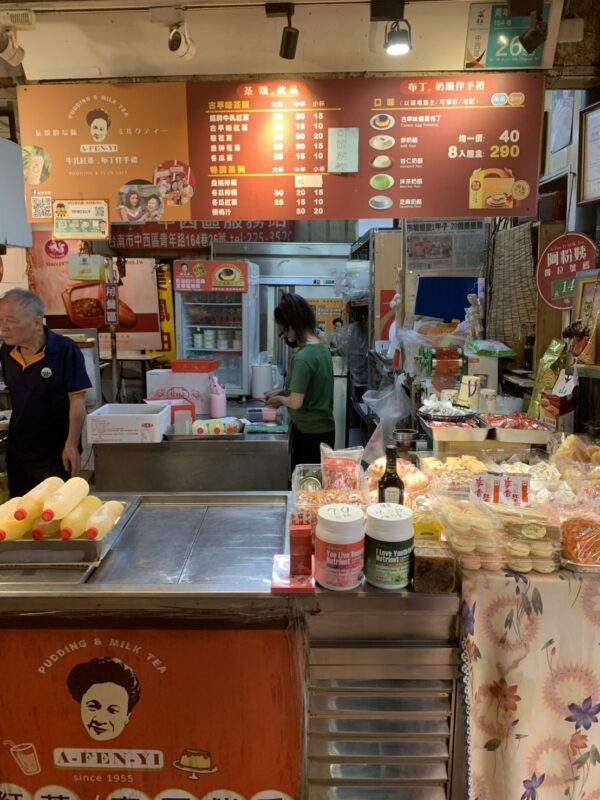
📍 A-Fen’s drinks stall: repairing the spirit once the body is fed
Having finished the consultation about today’s constitution and ingredients at Cheng’s, a customer turns and comes to A-Fen for a bag of chrysanthemum tea with astragalus and liquorice. It is a relay of the senses: Cheng’s looks after your stomach and your strength, A-Fen looks after your energy and your calm. That complementarity forms the sensory ecosystem particular to Dongcaishi.
Tainan’s markets hold the most honest traditional medicine there is. A-Fen’s drinks are not bubble tea; her formulas follow the season and your condition. Like the proprietor at Cheng’s, her core skill is reading people.
📍 A curator of first-class fruit: an understanding about quality, not price
Next to Cheng’s you will not see fruit piled carelessly; each piece rests on padding like a jewel. These craftspeople share an audience that will not compromise on the quality of daily life, and there is no price war between them – only a contest of honour over whose selection is more precise.
The fruit stalls at Dongcaishi choose the best of the season, the region and the day. You cannot ask which is cheapest, because the question has no meaning here. What you can ask is which is sweetest today, and you will get a serious and precise answer. That is the atmosphere of Dongcaishi: every stall silently reinforcing everyone else’s standard.
VOL. VIII / THE RESONANCE
A resonance between craftspeople:
from 3 Door Hotel to Cheng’s, protecting order.
At 3 Door Hotel we hold to the butler’s spirit – consideration expressed in the smallest details. When we walked into Cheng’s Butchery and saw Mr Cheng behind that glass case patiently removing lymph nodes and fascia from a single rib; when we heard the proprietor gently ask a customer who at home would be drinking this soup, we recognised the same soul.
At the core of that soul is an imaginative capacity for the person you cannot see. As the Cheng family cut, there is a faint figure in their minds – the person who will finally eat this meat at a table. They do not know that person, but they give them everything. Our butlers preparing a room think the same way: the guest has not arrived, but everything is already in place.
In 2026 the world is running out of control. But some things a machine can never imitate – the exact pressure of the Cheng family’s knife, the certainty in the proprietor’s eyes. 3 Door Hotel and Cheng’s Butchery operate on the same frequency: both of us offer travellers a kind of composure. When you carry away a piece of Cheng’s cured pork, what you carry is three hundred years of the old city’s elegance.
Curation Credits & Field Notes
A note on sources for this piece:
|
📺 Television records |
📖 Feature journalism |
|
📜 Official historical archives |
✍️ Notes from local food experts |
