
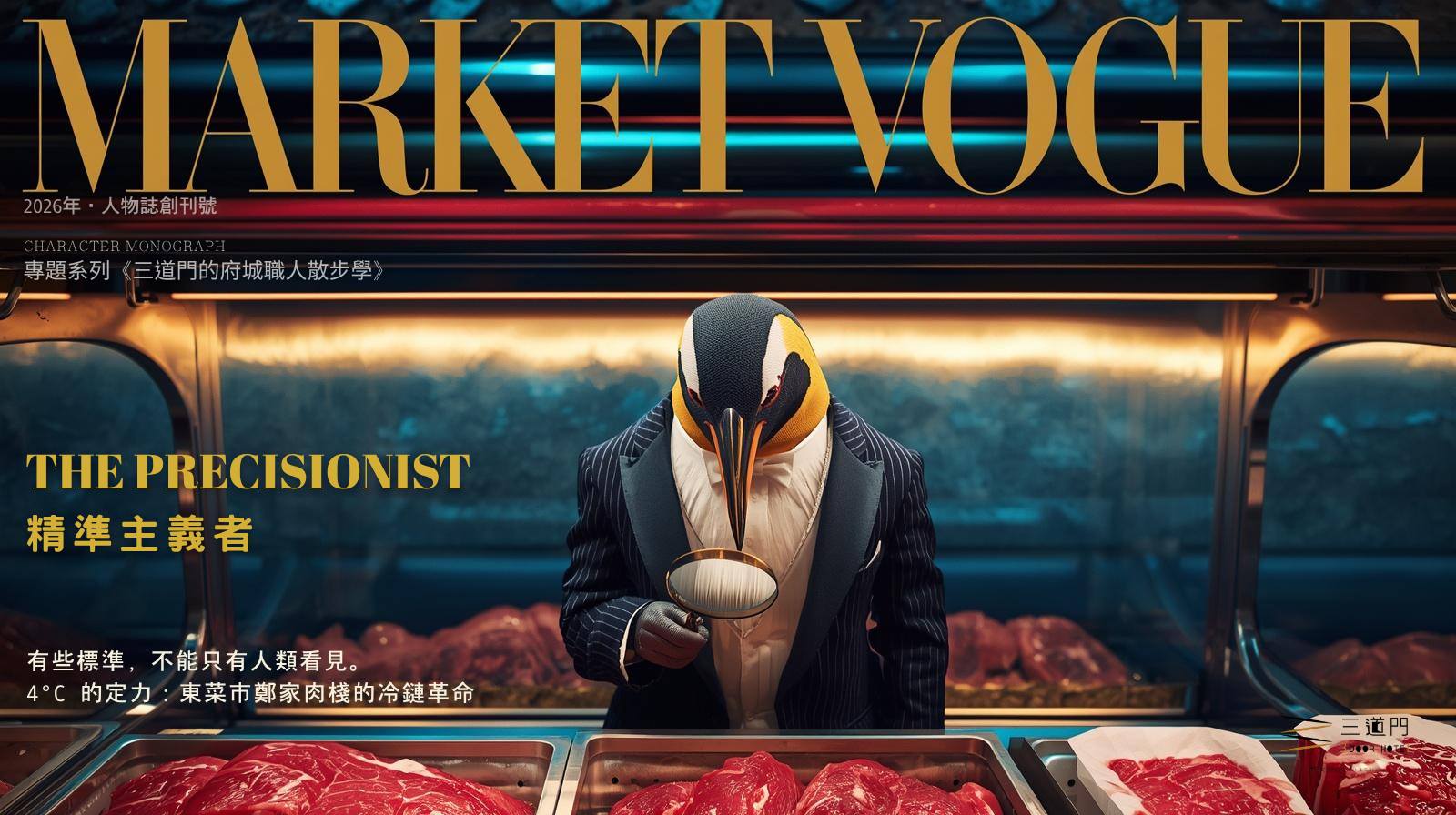
Tainan Artisan Walk by 3 Door Hotel
East Market: Zheng Family Meat Stall
A Century-Old Curation of Precisionism
From the cold chain revolution 30 years ago to psychological consultation behind the counter, decoding Tainan’s highest standard of taste aesthetics.
Editor-in-Chief / 3 Door Hotel
Why Write About Artisans?
If the market is the stomach of the city, then the artisans are the flesh and blood flowing through it.
In “Market Vogue’s” urban collection project over the past year, we have led travelers into five traditional markets in Tainan, writing about architecture, sounds, and tastes. But as we wrote, we discovered the most charming scenery isn’t the hardware, but the people who have stood before the same stall for three generations—they guard not just a business, but a near-obsessive adherence to “standards.”
This obsession, in an era dominated by efficiency and algorithms in 2026, appears incredibly precious and nearly endangered.
For our debut artisan monograph, we return to East Market—famously known as the “Wealthy People’s Market”—to find Zheng Family Meat Stall, a shop that has redefined the height of traditional butcheries. This is more than a story about pork; it is a long discourse on “steadfastness” (Ding-li)—in an era where the world has lost its patience, some still choose the “slow” way to do every single thing to the best of their ability.
|
|
Market Vogue Podcast · Character Series Ep.01 Zheng Family Meat Stall: The Blade Unchanged for Thirty Years |
Above Wuling:
Noble Genes at the Peak of the City
To read the unquestionable “precision” of Zheng Family Meat Stall, one must first read the terrain of Tainan.
The ancient city of Tainan was not flat; it was composed of seven undulating hills. In the Qing Dynasty, the highest hill, closest to the heart of power, was named “Wuling” (Eagle Hill)—the administrative offices sat right on its flank. Gathered atop Wuling were the city’s top talents and wealth. In 1908, East Market emerged, and from day one, its customers were anything but ordinary.
The first generation of Zheng Family Meat Stall established their family creed within this “gentry atmosphere.” In that social strata, a piece of pork was more than food; it was the “face” of a banquet, a persistence of “living order” in official mansions. You couldn’t serve second-rate meat to people who had standards for everything—they could taste the difference.
Once planted, these genes are hard to dilute. Three generations later, the Zheng family’s standards remain unchanged. This isn’t stubbornness; it’s a form of respect for the customer: if you come to me, you deserve the best.
TIMELINE · A Century of Steadfastness
| 1908 | East Market officially opens. Located on Wuling heights, serving high-ranking bureaucrats of the Qing and Japanese eras, establishing the gentry tone of “high quality, no haggling.” |
| 1920s | The first generation of Zheng Family enters. Near the core of power, they solidify the family gene of “no second-rate goods.” From day one, it was not a place for bargaining. |
| 1990s | Third-generation Zheng Zhi-xian initiates the cold chain revolution. While others still used ice, he introduced full stainless steel refrigeration, seen as an outlier by peers but a gold standard by customers. |
| 2026 | 3 Door Hotel resonates with the artisan spirit of Zheng Family. Transforming “steadfastness” into a deep walk for travelers to encounter this century-old standard. |
VOL. II / Loneliness of Cold Chain
The Rebel of Thirty Years Ago:
The Cold Revolution Behind Glass
More than thirty years ago, Tainan’s traditional markets were in a fever of “warm meat belief.” In the logic of the time, a good piece of pork had to be warm to the touch, allowing customers to press it with their fingertips. That ritual of direct contact was the ultimate confirmation of “freshness.”
Zheng Zhi-xian, the third-generation owner, made a commercial bet seen as a “betrayal of tradition”: he introduced the first “full low-temperature stainless steel refrigerated display cabinets” ever seen in Tainan’s traditional markets. Glass and cold air were a frontal challenge to market culture.
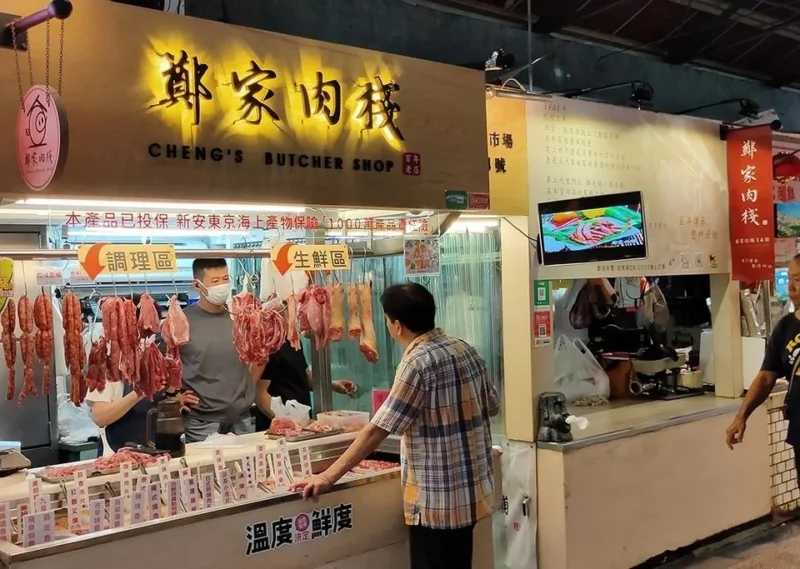
Zheng Family Meat Stall · Tainan Traditional Market Cold Chain Revolution
“The neighbors laughed at us, said we were crazy. If meat is locked in a glass box, how can customers touch it? If they can’t touch it, how will they believe it’s fresh?”
— Interview with Zheng Zhi-xian
But Zheng knew one thing: once meat leaves the constant 4°C zone, its cellular structure breaks down and umami is lost. In the markets of that era, pork delivered in the morning would begin to qualitively change under the Southern Taiwan sun—color, smell, elasticity silently telling those who knew that it was no longer at its peak.
Zheng chose the loneliest path. Amidst market skepticism, he installed that gleaming white stainless steel system. Initially, some regulars went elsewhere. But time is the most honest judge—the meat that stayed plump and red in the summer heat, and didn’t change color or weep fluids hours later, eventually brought the most discerning East Market foodies back. And they never left again. This cold space filtered out dust, sealed in freshness, and evolved into the market’s most indestructible “trust boundary.”
Every Cut is a Precise Prediction of the Final Dish
At Zheng Family Meat Stall, every piece of meat has a specific physical mission. The artisan’s task is to foresee the ultimate form of the meat in the pot at the moment the knife descends—a precise prediction based on a deep understanding of muscle fibers, fat distribution, and collagen density.

“Every cut is made to ensure the ingredient finds its final home on the dining table perfectly.”
Take “Pork Shoulder” (Mei-hua-rou) as an example. To ensure a slice remains as smooth as silk after a 30-second high-heat stir-fry, Zheng performs “fiber-oriented cutting.” The marbled fat distribution determines the heating uniformity—cut it the wrong way, and even the best ingredient will shrink into a piece of rubber.
Even more impressive is the treatment of “soft bone ribs.” Zheng insists on patiently removing the lymph nodes and fascia around the cartilage. This step is often skipped in traditional markets because it’s time-consuming and reduces the weight, meaning less profit. But Zheng’s logic is simple: every gram you take home should be worth the money you spent. This “purity” is the true height of the artisan: never lowering the standard where the customer can’t see.
VOL. IV / Counseling behind the Counter
The Meat Counselor:
Double Diagnosis of Insight and Intention
At Zheng Family Meat Stall, the owner’s wife isn’t just a cashier; she is a “culinary consultant” merging roles of nutritionist, cooking coach, and counselor. There is no shouting here, only a low murmur reminiscent of a clinic consultation.
She doesn’t just listen; she observes your expression, the day’s humidity, even the flow of the seasons. If you say, “My mother isn’t feeling well and wants a nourishing soup,” she won’t just hand you meat—she’ll ask questions: How old? What’s the discomfort? How is her appetite? Is her stomach sensitive?
In an AI era of de-humanization, they have guarded “deep human-to-human insight.” You take home pork, but you also take a memory of being treated with sincerity—a feeling often more healing than the food itself.

Zheng Family Meat Stall · Three Generations, One Standard
The Butchery’s “Wellness Consultation” Syllabus
| Cooking Need | Recommended Cut | Zheng Family Secret |
|---|---|---|
| Nourishing soup for kids | Premium soft bone ribs | Complete removal of lymph nodes and fat membranes. Pure bone marrow essence that is clear and non-aggravating. |
| Quick weekday dinner | Cross-cut shoulder meat | Artisan cross-cutting against the grain breaks tough fibers. Tender in 30 seconds; no shrinking or toughness. |
| Elders’ lung nourishment | Tenderloin (Pork Fillet) | The most tender part with zero fat burden. Perfect for long, gentle slow-cooking for a clear, light broth. |
| Festival banquet dishes | Pork Belly (Three-layer) | Strictly selected fat-to-meat ratio. Clear layers without being too greasy. Perfect for braised or pot-roasted dishes. |
VOL. V / Alchemy of Taste
Salted Pork and Steamed Pork: The Aesthetics of Sealed-in Time
On the tables of Tainan’s gentry, Zheng’s salted pork (Xian-zhu-rou) is never just a dish. Behind it is an underrated Tainan version of Charcuterie—the secret lies in the old-style red yeast and the three-generation five-spice ratio.
This isn’t chemical seasoning; it’s a slow “micro-aging.” Every batch of spice mix is adjusted according to the season’s humidity and temperature. Tainan’s summer and winter have vastly different effects on spice penetration. This detail can never be handled by vacuum-packing machines; it requires a seasoned nose to smell and feel every day.
“Good cured meat shouldn’t mask the aroma of the pork, but awaken the century-old echoes sleeping within the fat.”
When you pan-fry this meat, the melting fat carries woody fragrances—the second soul time gives to the pork. The “Steamed Pork with Rice Flour” (Fen-zheng-rou) further solves the pain point of modern people wanting to eat well but having no time. The artisan takes on the tedious curing work to allow you an effortless “refinement” on your table.
VOL. VI / Contract of Trust
Why the “Zheng Family” Name is Worth More than Certificates?
In Tainan’s East Market, there is something sturdier than a certification seal: Personal Credit Guarantee. Regulars here don’t even look at the scale, because every gram is backed by a century of reputation. You don’t need to comparison shop or study origin labels—you just walk to the glass counter, say what you want, and trust those hands.
In an age of misinformation and food safety scares, this trust is incredibly rare. You can buy meat with all the certifications, but you can’t buy “someone willing to be responsible for your health.” Zheng guards the most primal human promise: I choose the best for you because your family’s stomach matters.
True luxury is an unspoken understanding between provider and consumer. When you buy Zheng’s meat, you buy the city’s most scarce resource: “The Right to Peace of Mind.”
Neighborhood Guide
Elegant Satellites of East Market:
A Group Evolution of Standards
Here, no shop is an island.
📍 A-Fen-Yi Drinks: Soul Repair after Bodily Satisfaction
After a “constitution and ingredients” consultation at Zheng’s, customers turn to A-Fen-Yi for chrysanthemum tea with astragalus and licorice. It’s a sensory relay: Zheng cares for your “stomach and stamina,” while A-Fen-Yi adjusts your “Qi and tranquility.” This complementarity forms the unique sensory ecosystem of East Market.
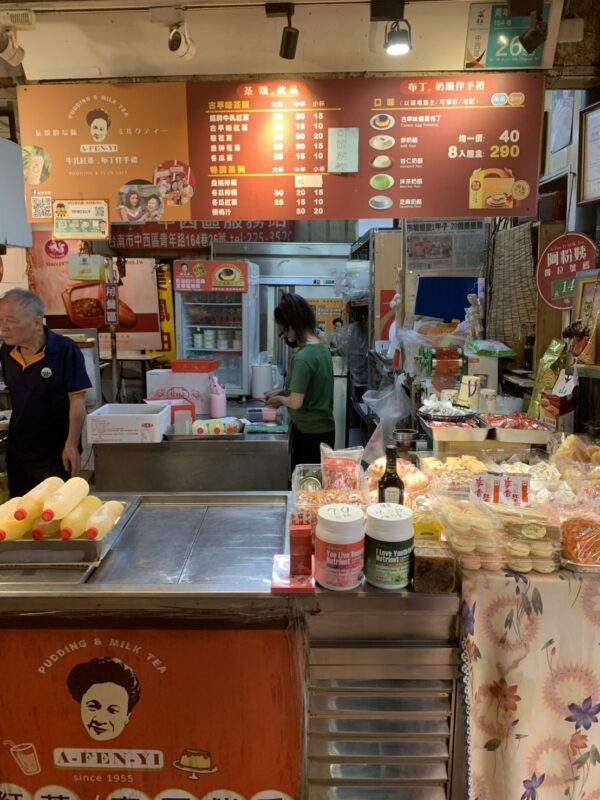
📍 Top Fruit Curators: Quality Consensus over Price
Next to Zheng’s, fruits aren’t just piled up—they are placed in jewelry-like padding. These artisans share the same uncompromising audience. There are no price wars, only a competition of “whose curation is more precise.” You don’t ask for the cheapest here; you ask “what is the sweetest today” and get an honest, precise answer.
VOL. VIII / THE RESONANCE
Artisan Resonance:
From 3 Door to the Zheng Family, Guarding Order.
At 3 Door Hotel, we value “Butler Spirit”—extreme thoughtfulness shown in tiny details. When we enter Zheng Family Meat Stall and see Mr. Zheng patiently removing lymph nodes from a rib behind that glass; when we hear his wife tenderly asking “who at home is drinking this soup today,” we see the same soul.
The core of this soul is imagination for the “unseen person.” When Zheng cuts meat, he has a blurry figure in mind—the person who will eventually enjoy it at the table. They don’t know him, but they give their all for him. A 3 Door butler has the same mindset when prepping a room. The guest isn’t here yet, but everything is in place.
In the Fire Horse Year of 2026, the world is running out of control. But machines can never simulate the strength in Zheng’s cut or the certainty in the owner’s eyes. We both provide travelers with “steadfastness.” When you take home Zheng’s meat, you take home 300 years of Tainan’s elegant echoes.
Curation Credits & Field Notes
|
📺 TV Visual Records |
📖 Media Features |
