

🎋 🥟 🍃
The Dragon Boat holiday food showdown
North vs south zongzi, savoury rice pudding and minced pork rice explained – plus three local favourites for zongzi in Tainan and where to stay
As the Dragon Boat Festival comes round, the air fills with the scent of bamboo leaves and glutinous rice. Beyond the boat races and standing eggs, what most people look forward to is a plump, generously filled zongzi. But before you start eating, have you ever wondered about the north-south zongzi war that plays out every year?
Today we are unpacking that north-south divide, sharing a classic story behind the festival, and finishing with the zongzi shops locals queue for daily and a very convenient place to stay. Save this and start planning your festival food trip.
Everyone knows you eat zongzi at the festival, but did you know the custom began with an attempt to rescue a patriotic poet?
In the Warring States period, so the story goes, the patriotic poet Qu Yuan of Chu grieved for his country and its people, and watching disaster approach without being able to prevent it, he took up a stone and drowned himself in the Miluo River on the fifth day of the fifth month. Hearing the news, the local people were distraught, and to stop the fish and shrimp from devouring his body they rowed out in boats – this is the origin of dragon boat racing – and threw rice wrapped in leaves into the river to feed them. That thoughtful act of wrapping rice in leaves, transformed over more than two thousand years and combined with local ingredients everywhere, became the richly flavoured zongzi on our tables today.

🔍 Which camp are you in? A north-south showdown of Taiwanese classics
Taiwan is not large, but its food culture is remarkably varied. It is not only zongzi that divide north and south: everyday savoury rice pudding and braised pork rice look entirely different to people from either end of the island.
🍙 1. Zongzi: steamed or boiled, a contest of texture
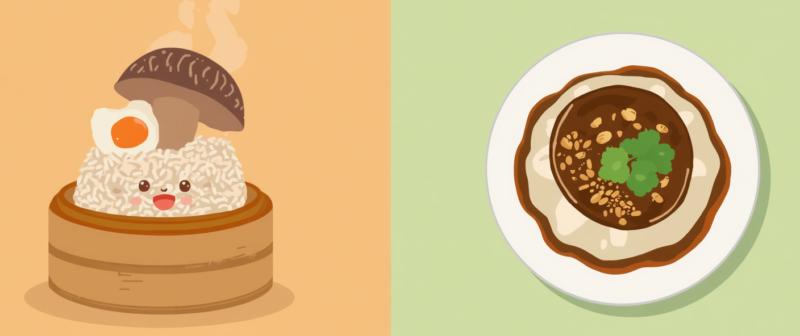
- Northern zongzi (the soul of oily rice, grain by grain):
Northern zongzi stir-fry the glutinous rice and fillings (pork, mushroom, salted egg yolk) until half cooked, then wrap them in bamboo leaves and steam them through. The texture is distinct grain by grain, chewy and springy, and the aroma is rich – very much like delicious oily rice wrapped in a leaf. - Southern zongzi (moist, soft, and all about the ingredients):
Southern zongzi wrap raw glutinous rice and cooked fillings directly in makino bamboo leaves and boil them in a large pot. Because the rice absorbs water fully, the texture is moist, sticky and fine enough to melt in the mouth. You must add the special sweet thick soy sauce, then a generous layer of peanut powder and coriander – that is the authentic southern way.
🥣 2. Savoury rice pudding: pale and clean vs. dark and savoury
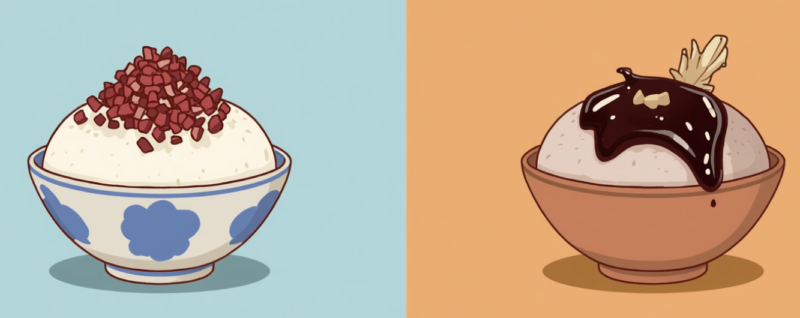
- Northern and central rice pudding (the clean camp):
Usually steamed from plain rice batter, giving a clean off-white colour. The toppings – salty preserved radish, minced pork, dried tofu – are added after steaming, so you taste the faint sweetness of the rice against the savouriness on top. - Southern rice pudding (the rich camp):
In the south, soy sauce or braising liquid goes into the batter itself, so the steamed result is an appetising deep brown. The fillings – mushroom, egg yolk, pork – are mixed into the batter and steamed together, giving a moist texture and a rich savoury aroma in every mouthful.
🍚 3. Braised pork rice vs. minced pork rice: a naming trap when ordering

- In the north:
What northerners call lu rou fan is finely cut pork with skin and fat, braised until glossy and full of gelatine, over rice; rou zao fan usually means a leaner minced pork version. - In the south:
In the south, that glossy dish of skin-on, fatty diced pork is called rou zao fan. Order lu rou fan in the south and the owner will usually bring you a whole slab of pork belly – what northerners call kong rou fan. Worth knowing when you order.
🍽️ Local favourites: three classic zongzi shops in Tainan
To taste the most authentic southern zongzi, go to their heartland: Tainan. These three shops each have their own character and a devoted local following, and all are well worth trying.
💚 1. Tainan Old Shop Vegetable Zongzi
A traditional shop of several decades’ standing, specialising in traditionalvegetarianzongzi – andstrongly recommended by localsas a classic Tainan breakfast. Their zongzi are wrapped in fragrant shell ginger leaves, the glutinous rice is fine-textured, and inside are large, soft peanuts. Dust them with peanut powder and coriander, then add the house thick soy sauce for a wonderfully plain, old-fashioned flavour. With a bowl of hot miso soup alongside, that is the local way.
⏰ Hours: Mon-Sun 05:30-15:00
🤎 2. Yuanxin A-Po Zongzi
Hidden down a lane and takeaway-only, yet the queue is constant – which tells you plenty. A-Po’s zongzi are known for honest ingredients and enough flavour not to need any sauce. The glutinous rice soaks up the juices while keeping its bounce, and the fillings include salted egg yolk, mushroom, lean pork and soft chestnut. The layers of texture make it hard to stop at one.
⏰ Hours: Mon-Sat 07:00-18:00 (closed Sundays)
🧡 3. A-Juan Zongzi and Lu Mian
On busy Guohua Street, this is another placestrongly recommended by localswhere you simply will not eat without queuing. The zongzi are fragrant and generously filled, but what makes it particular is that you can also try Tainan’s traditional lu mian here. The thickened broth is lightly sweet and sour, loaded with daikon, mushroom and pork, and together with a zongzi it is deeply satisfying. The taro congee on certain days is another item the regulars come for.
⏰ Hours: Mon-Sat 07:00-14:00 (closed Sundays)
🎒 The perfect base for a Tainan food trip: transport and design in one
To work through those zongzi and local snacks comfortably, choosing a well-connected, well-equipped place to stay matters enormously.
Among the manyrecommended places to stay near Tainan Railway Station,“3 Door Hotel“stands out for its location. The hotel is only an eight-minute walk from Tainan Railway Station, which makes it convenient whether you arrive by public transport or plan to drive to the food destinations of West Central and North districts – A-Juan on Guohua Street, the vegetable zongzi on Ximen Road, and the rest.
Beyond the transport, 3 Door Hotel folds in distinctive architectural aesthetics and design, offering a comfortable and well-made place to rest. After a day of Tainan food and monuments, you return to attentive butler service and a quiet space – a fine full stop to a Dragon Boat food trip.
💡 [Reader Q&A]
❓ Q1: What is the simplest way to tell northern and southern zongzi apart?
A1: Look at how the rice is cooked and how the parcel is finished. Northern zongzi stir-fry half-cooked rice and fillings for fragrance, wrap them and steam them, giving a springy, distinct-grained texture. Southern zongzi wrap raw rice and fillings and boil the whole parcel, giving a softer, finer, stickier result.
❓ Q2: Is Tainan’s well-known vegetable zongzi suitable for vegetarians?
A2: Yes. Tainan’s traditional vegetable zongzi is very simple – glutinous rice and large peanuts, wrapped in shell ginger leaves – and contains no meat at all, making itfully vegetarian. That said, it is worth checking with the shop whether the accompanying soy sauce or miso soup is also vegetarian, for complete peace of mind.
❓ Q3: Why is southern savoury rice pudding so much darker than the northern kind?
A3: Because soy sauce or braising liquid goes into the batter in the south, so it steams to a tea-brown colour with a savoury aroma of its own. Central and northern versions are usually made with plain rice batter and come out white, with the toppings added afterwards.
❓ Q4: Any advice on queuing at A-Juan or Tainan Old Shop Vegetable Zongzi?
A4: Both are local favourites, and popular items – A-Juan’s limited savoury congee and lu mian, for instance – often sell out by around midday or earlier. Arrive about half an hour before opening to be sure of trying everything on the signature list.
❓ Q5: What are the advantages of choosing 3 Door Hotel for a Tainan food itinerary?
A5: As a popularrecommended places to stay near Tainan Railway Station, 3 Door Hotel’s greatest strength is how easy it is to reach. You can walk there from the station, and the food heartlands of Guohua Street in West Central District and Ximen Road in North District are within a few minutes. It saves a great deal of travel time and makes an excellent base for exploring Tainan’s street food.
